Most Challenging Levels In Geometry Dash
The level called the hardest in Geometry Dash is always changing. “Society” currently holds the #1 spot on the Demonlist as of August 19, 2026, replacing older names that once defined the game's difficulty ceiling.
In this guide, we'll cover the hardest Geometry Dash levels right now, explain how the rankings work, and look back at the legendary Extreme Demons that pushed players to new limits.
How “Hardest” GD Level Is Actually Decided
The Geometry Dash Demonlist is the main community ranking for the game's hardest Demon levels. It tracks difficult levels through the Main, Extended, and Legacy lists. The Main List holds the current top levels, while Extended and Legacy preserve levels that have fallen below the main ranking.
Main, Extended, and Legacy - New levels can push older ones down as players verify and complete harder challenges. This keeps the ranking active rather than making it a fixed list.
Verification Is the Gate - A level must meet Pointercrate's rules and have legitimate completion proof before it can receive a ranking. This means the #1 spot can change whenever a harder level is verified and placed above it.
Demon Is Not One Difficulty - Demon difficulty includes Easy, Medium, Hard, Insane, and Extreme Demon. Most of the levels in the hardest-level rankings are Extreme Demons, which sit at the highest end of Geometry Dash difficulty.
The Hardest Levels Right Now
Last checked: August 19, 2026. The current Pointercrate Demonlist places Society by Neomarbilan at #1. Thinking Space II and Flamewall follow closely behind, while Tidal Wave remains in the top five.
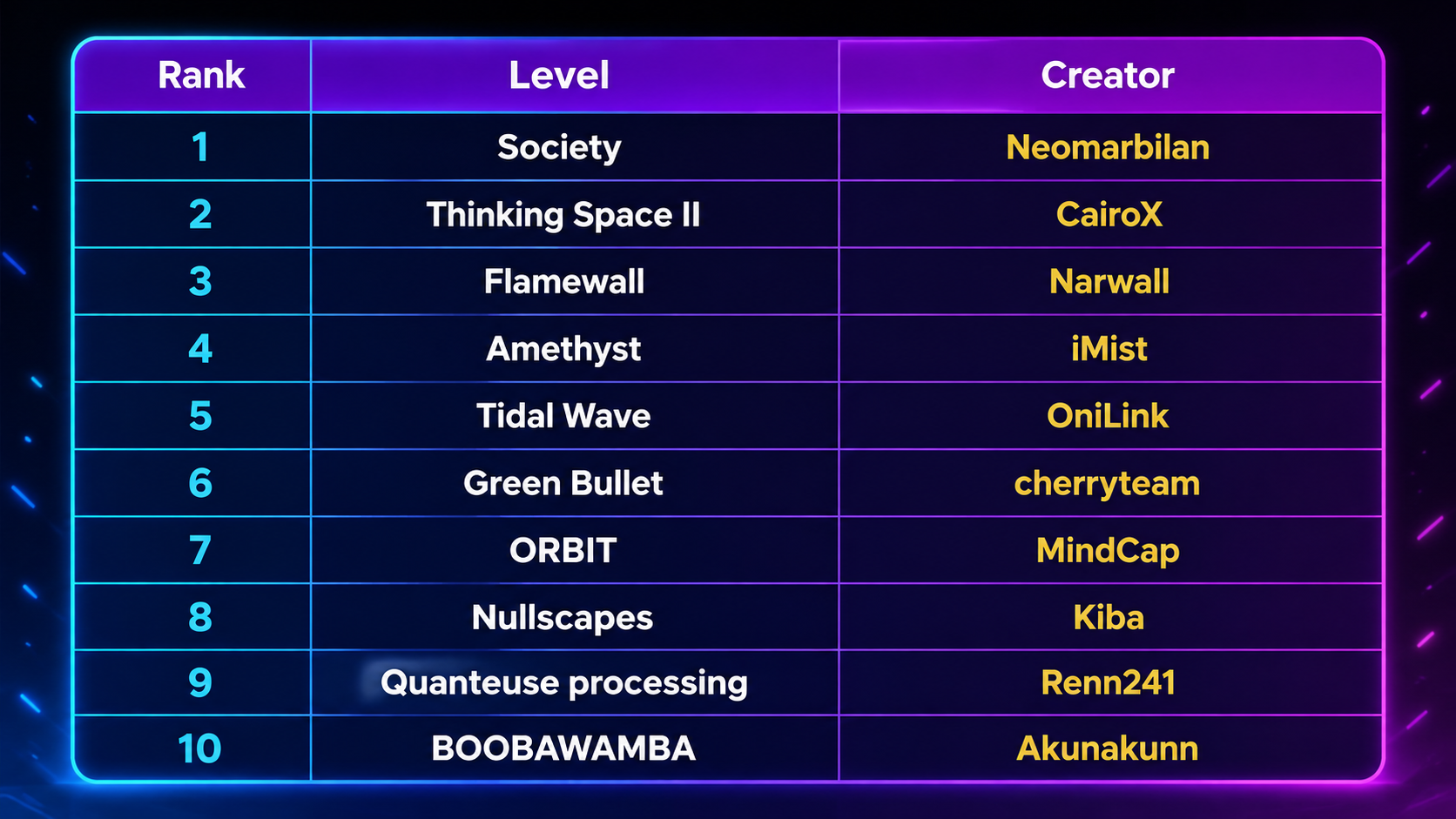
The list can change quickly as new Extreme Demons are verified and rated. Pointercrate currently shows The Bloop at #11, followed by Every End at #12 and Penumbral at #13. Silent clubstep sits at #14, showing how quickly older top levels can move down as new challenges arrive.
The main point is that the ranking is not permanent. A level can remain brutally difficult while falling several places because the community keeps producing harder challenges.
The Old Legends - And Where They Sit Today
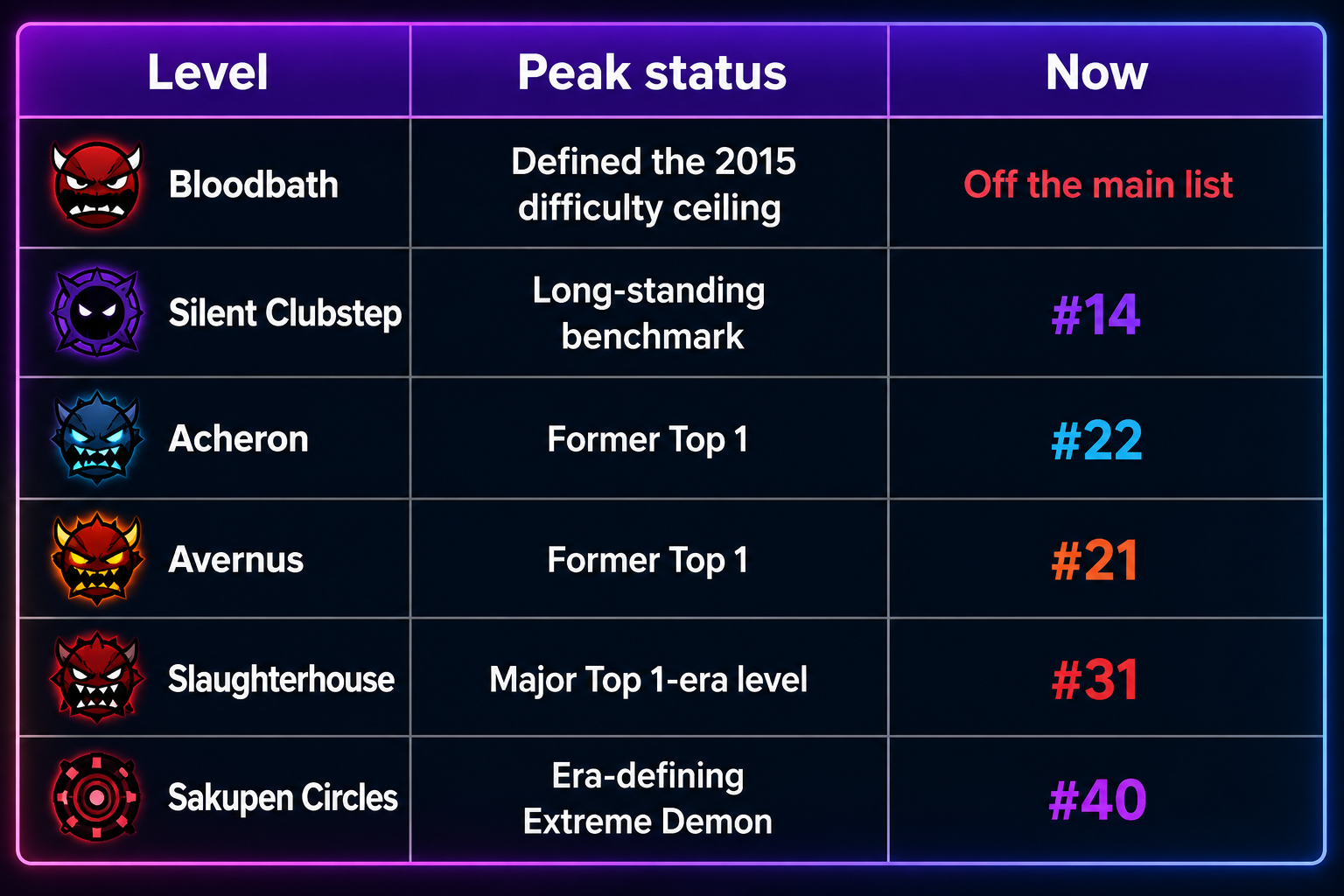
Some Geometry Dash levels once looked impossible but have since fallen down the Demonlist as harder levels appeared. That does not make them easy. It shows how quickly the game's skill ceiling has grown.
Why They Fell
These levels did not become easier. Players became better, practice methods improved, and creators learned from earlier Extreme Demons. New levels also use tighter gameplay and more complex patterns, pushing the top of the ranking higher. Pointercrate currently places Silent Clubstep at #14, Avernus at #21, Acheron at #22, Slaughterhouse at #31, and Sakupen Circles at #40.
They Still Matter
Beating an old Top 1 such as Acheron is still a major achievement. Its lower ranking does not turn it into a casual level. The ranking simply reflects how much the highest level of Geometry Dash skill has advanced.
The Zoink Point
Zoink's record is another sign of that skill growth. He has verified several former or current Top 1-level challenges, including Acheron and other major Demonlist levels. His completions show how elite players continue to push the limits of what can be done in Geometry Dash.
What Makes an Extreme Demon Extreme
An Extreme Demon is difficult because it combines several demanding skills instead of relying on one hard section. Tight timing windows can punish tiny input errors, while fast Wave and Ship parts require precise control. Some levels also use heavy visual effects or memory-based gameplay, making it harder to read the correct path.
Consistency Is the Real Challenge
The hardest part is not simply reacting quickly. A player might pass a difficult section once but still fail to repeat it consistently. Extreme Demons combine many such sections into one long run, so players must perform them correctly without losing focus.
This is why top-level GD players can spend thousands or even far more attempts on a single level. The goal is not to survive one difficult click. It is to reproduce every difficult input from start to finish. At this level, consistency matters as much as raw reaction speed.
The Hardest Official Levels
Not every player is ready for an Extreme Demon. If you want to test your skills using official Geometry Dash content, the three classic Demon levels are Clubstep, Theory of Everything 2, and Deadlocked. Fingerdash is also challenging, but it is rated Insane rather than Demon.
Why Clubstep Breaks Players
Clubstep is often the first major wall because it introduces tighter Ship control, fake paths, and tricky transitions. It teaches skills that become important in harder custom levels, especially controlled movement and learning to ignore visual traps.
Deadlocked Is the Real Wall
Deadlocked pushes the difficulty further with fast gameplay, Wave sections, dual sequences, and teleportation. Its Wave sections can be especially demanding for players who have not built strong Wave control.
For many players, the practical progression is Clubstep → Theory of Everything 2 → Deadlocked. However, the exact order can vary by player because different game modes feel harder to different people.
Clearing all three official Demon levels is a strong milestone. You will still be far from the Demonlist, but you will have built a solid foundation for harder community levels.
Where To Actually Start With Demons
If you are new to Demon levels, do not jump straight into an Extreme Demon. Start with Easy Demons that let you practice timing, movement, and level reading without overwhelming you. The Nightmare and The Lightning Road are two common beginner choices, followed by levels such as Platinum Adventure and Speed Racer.
Easy Demons First
Your first goal should be consistency, not difficulty. Beat several Easy Demons before moving to Medium Demon levels. This gives you time to improve different game modes and learn how Demon gameplay differs from normal official levels.
Build in Order
A simple progression is Easy → Medium → Hard → Insane → Extreme Demon. You do not have to follow this order perfectly, but skipping several tiers can leave gaps in your skills.
Fix Your Weakest Gamemode
Pay extra attention to the gamemode that causes the most deaths, especially Wave or Ship. Improving that weakness will make harder Demons much more manageable. For structured practice, combine this progression with focused section training instead of only playing full levels.
FAQs
What Is The Hardest Geometry Dash Level Right Now?
The hardest level can change as new Extreme Demons are verified and ranked. For the current answer, check the live Pointercrate Demonlist rather than relying on an older article, because the ranking can move when new levels enter.
Is Bloodbath Still Hard?
Yes. Bloodbath remains a very difficult Extreme Demon even though it no longer sits near the top of the Demonlist. Its lower ranking reflects the growth of player skill and level design, not a drop in the level's actual difficulty.
How Many Attempts Does An Extreme Demon Take?
There is no fixed number. A strong player may need thousands of attempts, while a newer player can need far more. The hardest levels can require tens of thousands of attempts because consistency matters across the entire level.
Can You Play Demonlist Levels In A Browser?
Some Geometry Dash levels can be played in browser-based versions, but the newest Demonlist levels are generally not available with the same setup or performance as the full game. For serious Demon grinding, the full game is the better choice.
Conclusion
The hardest Geometry Dash levels are not a fixed target. As players improve and creators build more demanding gameplay, new Extreme Demons continue to push the skill ceiling higher.
Older legends such as Bloodbath still matter because they helped shape that progress. If you want to start the climb, focus on easier Demons, build consistency, and move up one difficulty tier at a time. Check the Demonlist regularly for the latest rankings.